While over 95% of headaches are benign tension headaches, migraines, or sinus issues, a headache caused by a brain tumor follows a distinct pattern: it gradually worsens over weeks, peaks in the early morning or wakes you from sleep, intensifies when coughing or bending over, and resists routine painkillers. When paired with unexplained morning nausea, blurred or double vision, first-time seizures, balance issues, or subtle personality changes, you should consult a neurosurgeon promptly for an MRI evaluation.
Almost everyone experiences headaches caused by screen fatigue, stress, dehydration, or skipped meals. Because headaches are so common, it is natural to reach for an over-the-counter pain reliever and push through the day. Yet one of the most frequent concerns patients bring to neurosurgical clinics is a simple, anxious question: “How do I know if my headache is routine—or something serious?”
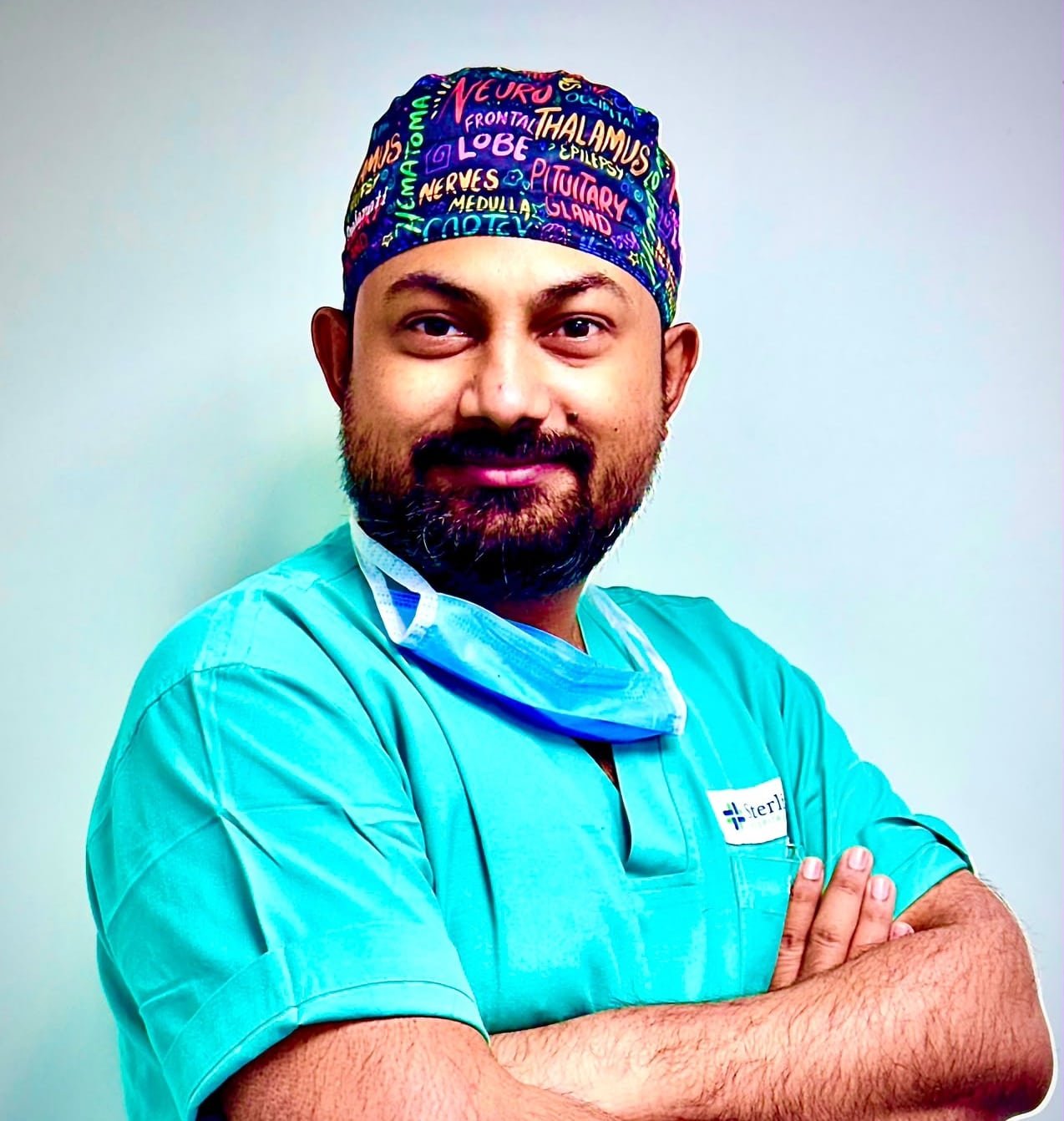
As a Consultant Neurosurgeon and Brain & Spine Specialist at Sterling Hospital, Gurukul, Ahmedabad, Dr. Ankit Prajapati emphasizes that early recognition makes a decisive difference in neurological outcomes. Not all brain tumors are cancerous—many are slow-growing, benign growths such as meningiomas or pituitary adenomas. However, because the skull is a rigid, closed space, any abnormal growth gradually increases pressure on delicate brain tissue and critical nerves. Learning to distinguish everyday headaches from neurological warning signs empowers you to seek timely care when treatment is safest and most effective.
Regular Headache vs. Brain Tumor Headache:
A brain tumor headache rarely appears as a single isolated bad day. Instead, it creates a progressive pattern driven by rising intracranial pressure inside the skull:
| Feature | Common Tension / Migraine Headache | Potential Brain Tumor Headache |
| Timing & Pattern | Often builds during stressful afternoons or after triggers | Often worst in the early morning or wakes you from sleep |
| Effect of Posture & Straining | Often eases when lying down in a dark, quiet room | Worsens when lying flat, coughing, sneezing, or bending over |
| Progression Over Time | Follows a familiar, predictable pattern over years | New-onset headache that steadily increases in frequency and severity over weeks |
| Response to Medication | Improves reliably with rest, hydration, or standard painkillers | Increasingly resistant to routine over-the-counter pain medicines |
| Accompanying Signs | Light sensitivity or temporary migraine aura | Paired with morning vomiting, vision shifts, weakness, or seizures |
7 Early Brain Tumor Symptoms You Shouldn’t Ignore
Because different regions of the brain control movement, vision, speech, memory, and balance, early tumor symptoms depend heavily on where the growth is located. Beyond persistent headaches, watch closely for these seven warning signs:
1. Unexplained Morning Nausea or Vomiting
Nausea that strikes first thing in the morning—completely unrelated to stomach acidity or food—occurs when elevated pressure inside the skull stimulates the brain’s vomiting center.
2. Gradual Vision Changes (Blurry, Double, or Tunnel Vision)
Tumors near the optic nerves, pituitary gland, or occipital lobe can press on visual pathways. Patients may notice double vision, unexplained blurriness that new eyeglasses fail to fix, or loss of peripheral (“side”) vision—such as bumping into doorframes.
3. First-Time Seizures or Subtle Muscle Twitching
Experiencing a seizure for the first time in adulthood is one of the strongest medical red flags for a brain lesion. Seizures do not always look like full-body convulsions; they can appear as sudden blank staring spells, brief confusion, involuntary twitching in one hand or facial muscle, or smelling strange odors that aren’t there.
4. Loss of Balance, Dizziness, or Clumsiness
Growths affecting the cerebellum or brainstem disrupt physical coordination. Warning signs include unsteady walking, stumbling while climbing stairs, difficulty buttoning shirts, or sudden clumsiness with fine hand movements.
5. Subtle Personality, Mood, or Memory Shifts
Tumors in the frontal or temporal lobes often cause quiet cognitive or behavioral changes that family members notice before the patient does. Examples include uncharacteristic irritability, sudden apathy, poor judgment, trouble concentrating at work, or forgetting familiar routines.
6. Speech Slurring or Word-Finding Difficulty
Struggling to recall common words, mixing up sentences, slurring speech, or having trouble understanding conversations can signal pressure on the brain’s language centers.
7. One-Sided Weakness, Numbness, or Hearing Ringing
Gradual heaviness, tingling, or weakness in one arm or leg points toward motor pathway compression. Similarly, persistent one-sided hearing loss or ringing in one ear (tinnitus) warrants evaluation of the auditory nerve.
How Doctors Diagnose a Brain Tumor Accurately
If you visit a neurosurgeon with persistent headaches or neurological symptoms, evaluation is painless, systematic, and non-invasive:
-
Detailed Neurological Examination: Testing eye movements, optic nerve health, reflexes, muscle strength, balance, and memory.
-
Contrast-Enhanced MRI Brain Scan: The gold standard for detecting even tiny brain growths, showing exact tumor size, fluid swelling, and proximity to vital nerves.
-
Advanced Functional & Tractography Imaging (DTI): Maps critical nerve fibers controlling speech and movement around the tumor before any treatment plan is made.
Modern Brain Tumor Treatment
Hearing the words “brain tumor” understandably triggers fear, yet neurosurgical technology has transformed patient safety and recovery. Treatment is customized based on whether a tumor is benign or malignant, its exact location, and the patient’s overall health:
-
Neuronavigation-Guided Microsurgery: Acting like a high-precision 3D GPS for the brain, intraoperative neuronavigation allows the surgeon to plan the smallest, safest corridor to remove a tumor completely while protecting surrounding healthy brain tissue.
-
Endoscopic Skull-Base & Keyhole Approaches: Select tumors near the pituitary gland or skull base can be removed through natural nasal corridors using high-definition endoscopes—leaving no external facial scar and enabling faster hospital discharge.
-
Awake Craniotomy with Real-Time Brain Mapping: When a tumor lies close to speech or motor centers, specialized awake brain mapping lets the surgical team monitor speech and limb movement live during tumor removal, maximizing safe resection while preserving neurological function.
-
Targeted Radiation (Stereotactic Radiosurgery) & Medical Oncology: For small, deep-seated, or residual tumors, focused radiosurgery and targeted therapies control tumor cells with pinpoint accuracy.
Frequently Asked Questions (FAQs)
1. Are all brain tumors cancerous?
No. More than half of primary brain tumors—such as meningiomas, pituitary adenomas, and acoustic neuromas—are benign (non-cancerous). Even though benign tumors do not spread to other organs, they still require timely evaluation because their growth inside the skull can press on vital brain structures.
2. Can a brain tumor cause headaches without any other symptoms?
In the earliest stage, a headache may be the only noticeable symptom, especially if the tumor is growing slowly. However, as pressure builds or surrounding pathways are affected, additional clues such as morning nausea, mild visual blurriness, fatigue, or memory lapses typically emerge.
3. When should I get an MRI scan for a persistent headache?
A neurosurgeon generally recommends a brain MRI if a headache is brand-new after age 40, steadily worsens over several weeks, wakes you up from sleep, triggers morning vomiting, fails to respond to medication, or is accompanied by vision changes, weakness, or seizures.
4. Do mobile phones or Wi-Fi cause brain tumors?
Large-scale global health studies conducted over decades have found no conclusive scientific proof that everyday mobile phone use or Wi-Fi exposure directly causes brain tumors. Known risk factors remain rare genetic syndromes (such as neurofibromatosis) and prior high-dose ionizing radiation to the head.
5. Is brain tumor surgery safe today?
Yes. With modern 3D neuronavigation, high-magnification surgical microscopes, intraoperative neuromonitoring, and dedicated neuro-ICUs, brain tumor surgery is significantly safer and less invasive than in the past, with most patients returning to normal daily activities far sooner.
6. What is the recovery timeline after modern brain tumor surgery?
For uncomplicated minimally invasive or neuronavigation-guided tumor resections, patients typically mobilize within 24 to 48 hours after surgery, stay in the hospital for 3 to 5 days, and gradually resume routine desk work within 3 to 4 weeks under neurosurgical guidance.
Consult an Experienced Brain Tumor Surgeon
A persistent, unusual headache is your body’s way of asking for clarity – not panic. Early evaluation either gives you immediate peace of mind or catches a treatable condition at its most manageable stage.
Dr. Ankit Prajapati, Consultant Neurosurgeon and Brain & Spine Specialist at Sterling Hospital, Gurukul, Ahmedabad, specializes in comprehensive brain tumor early symptoms and treatment, 3D neuronavigation-guided microsurgery, and minimally invasive neurosurgical care. If you or a loved one are experiencing persistent headaches or unexplained neurological symptoms, schedule a consultation with Dr. Ankit Prajapati for an accurate, reassuring medical evaluation.
Dr. Ankit Prajapati
Consultant NeurosurgeonDr. Ankit Prajapati is a leading Consultant Neurosurgeon specializing in advanced Brain and Spine Surgery, Minimally Invasive Endoscopy, and Neuro-Endovascular interventions. Practicing at Sterling Hospital, Gurukul, Ahmedabad, Gujarat - India, he leads comprehensive neurological and neurosurgical care for complex cranial and spinal conditions. His clinical expertise spans precision brain tumour surgery, endovascular stroke management, brain hemorrhage evacuation, and endoscopic treatments for slip disc and spinal fractures. Committed to clinical excellence and surgical safety, his patient-first approach integrates modern technology with dedicated neuro-critical care to ensure smooth recovery and long-term neurological wellness.