Endovascular Surgeries for Stroke by Dr. Ankit Prajapati
Endovascular surgeries for stroke are minimally invasive, catheter-based neuro-interventional procedures performed inside the blood vessels under real-time X-ray (fluoroscopy / Digital Subtraction Angiography) guidance to reopen blocked brain arteries, seal ruptured or unruptured blood vessel bulges, and prevent recurrent strokes without opening the skull. At Sterling Hospital, Gurukul, Ahmedabad, Dr. Ankit Prajapati (MBBS, MS, MCh Neurosurgery) is dual-trained in both open microsurgery and endovascular neuro-intervention, performing mechanical thrombectomy, carotid/intracranial angioplasty and stenting, endovascular aneurysm coiling/flow diversion, and AVM embolization to protect brain tissue and improve recovery outcomes.
When a stroke happens, every minute without blood flow threatens millions of brain cells. While intravenous clot-busting medications help many patients with acute ischemic stroke, large-vessel blockages and complex neurovascular conditions often demand direct, catheter-based repair inside the affected arteries.
As a Consultant Neurosurgeon and Brain & Spine Specialist at Sterling Hospital, Gurukul, Ahmedabad, Dr. Ankit Prajapati brings dual training in open microsurgery and endovascular neuro-intervention. This combined capability allows him to evaluate each patient’s vascular anatomy objectively and deliver targeted endovascular or microsurgical care—supported by rapid imaging and dedicated Neuro-Critical Care.
What Are Endovascular Surgeries for Stroke?
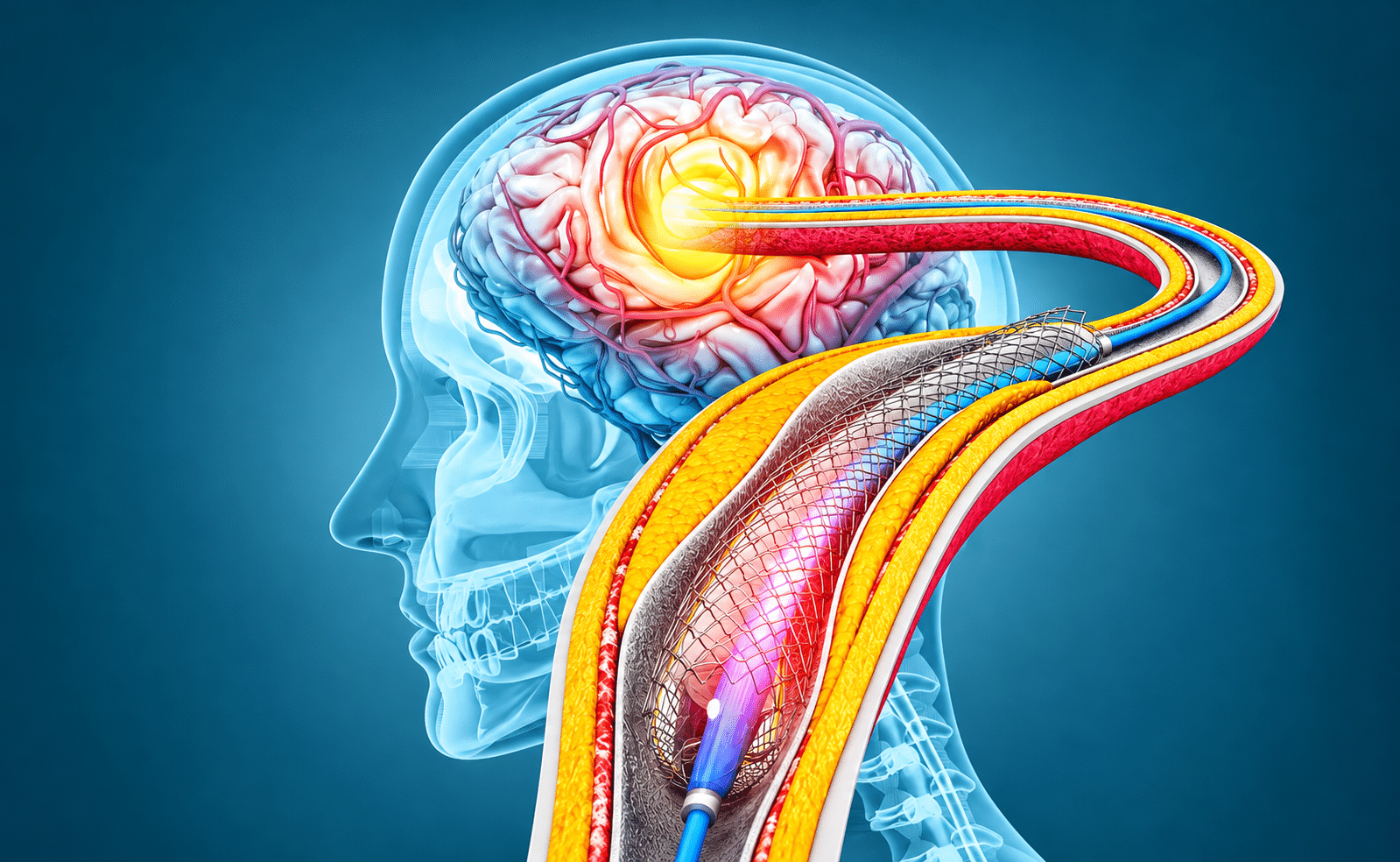
Endovascular neuro-intervention (often called keyhole blood-vessel surgery) uses thin, flexible micro-catheters introduced through a small puncture in the groin (femoral artery) or wrist (radial artery). Guided by live Digital Subtraction Angiography (DSA) imaging, the specialist navigates inside the arterial network directly to the brain or neck vessels to restore blood flow or seal a weakened vessel wall.
-
In Acute Ischemic Stroke (Blocked Artery): Endovascular therapy physically removes or aspirates a large blood clot blocking a major cerebral artery—or widens a severely narrowed artery—to restore oxygen-rich blood to salvageable brain tissue.
-
In Hemorrhagic / Aneurysmal Stroke (Bleeding or Weakened Vessel): Endovascular techniques seal a ruptured or high-risk brain aneurysm or occlude an abnormal blood vessel tangle (AVM) from inside the vessel, lowering the chance of re-bleeding without a traditional open craniotomy.
Key Endovascular Procedures for Stroke & Neurovascular Care
Depending on whether the patient is experiencing an acute stroke, recovering from a transient ischemic attack (TIA / “mini-stroke”), or managing a vascular lesion, Dr. Ankit Prajapati performs specialized endovascular treatments:
1. Mechanical Thrombectomy (Clot Retrieval)
For acute ischemic stroke caused by a large-vessel occlusion (LVO) in the brain, intravenous clot-busting medication alone may not dissolve a large, dense clot. During mechanical thrombectomy, a micro-catheter is threaded to the blockage to retrieve or aspirate the clot—using a stent retriever to capture and pull out the clot or aspiration catheter suction to clear the vessel. Restoring blood flow quickly saves the stressed yet salvageable surrounding brain tissue (the ischemic penumbra).
2. Carotid & Intracranial Angioplasty and Stenting
Narrowing (stenosis) of the carotid arteries in the neck or major arteries inside the brain—often caused by atherosclerotic plaque—is a major cause of ischemic strokes and TIAs. Angioplasty and stenting uses a tiny balloon to widen the narrowed segment and places a self-expanding mesh stent to prop the artery open and maintain smooth blood flow to the brain.
3. Endovascular Aneurysm Coiling & Flow Diversion
A brain aneurysm is a localized bulge on a weakened arterial wall that can rupture and cause a life-threatening subarachnoid hemorrhage. Through endovascular access, soft platinum coils can be packed inside the aneurysm sac to promote clotting and seal it off from blood pressure, or a flow diverter stent can be placed across the parent artery to redirect blood flow away from the bulge and encourage vessel wall healing.
4. Embolization of Arteriovenous Malformations (AVMs) & Dural AV Fistulas
Abnormal tangles of arteries and veins (AVMs) or abnormal dural arteriovenous shunts can cause brain hemorrhage, seizures, or stroke-like symptoms. Endovascular embolization delivers specialized embolic agents or coils precisely into abnormal shunts to reduce bleeding risk or prepare complex lesions for definitive treatment.
Who Is Eligible for Endovascular Stroke Treatment?
Candidacy depends on rapid clinical assessment, symptom onset (“last-known-well” time), and urgent neuro-imaging:
-
Acute Large-Vessel Ischemic Stroke: Patients presenting with sudden neurological deficits (such as one-sided weakness, speech loss, facial droop, or vision/balance changes) where CT/CT Angiography or MRI/MR Angiography confirms a large artery blockage. Treatment windows extend up to 6 hours in standard protocols and up to 24 hours in carefully selected patients whose advanced brain imaging shows salvageable tissue.
-
High-Risk Carotid or Intracranial Stenosis: Patients with recent strokes or TIAs linked to significant artery narrowing where stenting/angioplasty or surgical endarterectomy is appropriate alongside optimal medical therapy.
-
Ruptured or Unruptured Brain Aneurysms & Vascular Lesions: Evaluated individually based on aneurysm size, shape, location, rupture status, and overall patient health.
Benefits & Risks of Endovascular Stroke Surgery
Potential Benefits
-
Minimally Invasive Access: Performed through a tiny skin puncture rather than an open skull incision, avoiding muscle cutting and wide bone removal.
-
Rapid Reperfusion in Large-Vessel Stroke: Directly targets large clots in major brain arteries when every minute matters.
-
Shorter Recovery Window: Often allows faster transition to post-stroke monitoring and early neuro-rehabilitation compared with open surgery.
Potential Risks & Safety Considerations
Like all neuro-interventional procedures, endovascular stroke surgery carries important risks that Dr. Ankit Prajapati and the care team actively manage:
-
Bleeding or Vessel Injury: Intracranial hemorrhage, reperfusion injury after blood flow returns, vessel spasm, or perforation/dissection of an artery.
-
Clot Embolism or Re-Occlusion: Fragments of clot traveling downstream or re-narrowing of a treated vessel.
-
Access-Site & Contrast Effects: Groin or wrist bruising/bleeding, contrast dye reaction or kidney strain, or—for stented patients—the need for strict adherence to prescribed antiplatelet medications.
Emergency Action, Neuro-ICU & Post-Stroke Rehabilitation
Time is brain tissue. If someone shows sudden stroke warning signs—such as face drooping, arm weakness, slurred speech, vision loss, or sudden severe headache—seek emergency care immediately rather than waiting to see if symptoms pass.
At Sterling Hospital, Gurukul, Ahmedabad, patients who undergo endovascular stroke procedures are closely monitored in Dedicated Neuro-Critical Care for blood pressure control, neurological status, and complication prevention. Once stabilized, structured stroke management and rehabilitation – including neuro-physiotherapy, speech and swallowing therapy, occupational therapy, and long-term risk-factor control (blood pressure, diabetes, cholesterol, smoking cessation) – helps rebuild function and prevent future strokes.